NFPA 1910 pump test form
The short version: the annual fire pump service test that was in NFPA 1911 is now in NFPA 1910, Chapter 22 (2024 edition). Below is what the test asks for, taken from the 2024 text with the clause for each item, and a form that records the test as you run it.
When the test is due
Pump performance test: at least annually; after the repairs listed; and after any modification to the pump or to vehicle components used in pumping. (22.2)
The repairs that call for a test include:
- Removal of the pump transmission
- Removal of fire, wildland, ultra-high-pressure, or industrial pumps
- Removal of chassis transmission, pump PTO, or pump hydraulic drive
- Engine overhaul or removal
- Engine injector or injection pump replacement or repair
- Engine or transmission electronic control module (ECM) replacement or reprogramming
- Engine turbo charger replacement
- Radiator removal
The standard says the list includes these "but is not limited to" them.
The pumping runs
Each run is timed only once pressure and flow are steady at the test point. "Readings" is the least number of full sets (flow, discharge, intake and engine speed) to take during the run, and each run is reported as the average of its readings (22.8.2).
Fire pumps 250 gpm to under 3000 gpm
| Flow | Net pump pressure | At least | Readings | Clause |
|---|---|---|---|---|
| 100% of rated | 150 psi | 20 min | 5 | 22.7.8.2.1 |
| 100% of rated | 165 psioverload run, pumps 750 gpm and up only | 5 min | 2 | 22.7.8.2.1 |
| 70% of rated | 200 psi | 10 min | 3 | 22.7.8.2.1 |
| 50% of rated | 250 psi | 10 min | 3 | 22.7.8.2.1 |
Pumps 3000 gpm or more
| Flow | Net pump pressure | At least | Readings | Clause |
|---|---|---|---|---|
| 100% of rated | 100 psi | 20 min | 5 | 22.7.8.2.2 |
| 70% of rated | 150 psi | 10 min | 3 | 22.7.8.2.2 |
| 50% of rated | 200 psi | 10 min | 3 | 22.7.8.2.2 |
Wildland and ultra-high-pressure pumps
| Flow | Net pump pressure | At least | Readings | Clause |
|---|---|---|---|---|
| 100% of rated | rated net pump pressure | 30 min | every 15 min, at least 3 | 22.7.8.1.1 |
What else the test covers
NFPA 1910 lists these tests, as they apply to the apparatus (22.7.2):
- Engine speed test
- Pump shift indicator test
- Pump engine control interlock test
- Priming system test
- Vacuum test
- Pumping system test
- Pressure control system test
- Intake relief valve system test
- Gauge test
- Flowmeter test
- Tank-to-pump flow rate test
Priming (when testing from draft)
| Rated capacity | Prime within | Clause |
|---|---|---|
| 1250 gpm or less | 30 seconds | 22.7.6.5 |
| 1500 to under 3000 gpm | 45 seconds | 22.7.6.6 |
| 3000 gpm or more | 90 seconds | 22.7.6.7 |
Add 15 seconds to any of these limits when the pump has an auxiliary 4 in. (100 mm) or larger intake pipe holding 1 ft³ (0.0283 m³) or more. (22.7.6.8) The 2024 text gives no limit for pumps over 1250 gpm but under 1500 gpm.
Vacuum
- Reach at least 22 in. Hg (75 kPa).
- Above 2000 ft (610 m), the required vacuum drops 1 in. Hg (3.4 kPa) for each 1000 ft (305 m) above 2000 ft.
- Vacuum must not drop more than 10 in. Hg (34 kPa) in 5 minutes.
- Then close all intake valves, remove the cap or plug from each valved intake, and repeat steps (2)-(6).
NFPA 1910 22.7.7.
Pressure control
Set the device at each point, close all discharge valves in 3 to 10 seconds (not timed for UHP pumps), and the pressure rise must not exceed the limit. The text sets no limit on how long the rise may last; only UHP pumps get a timed hold (3 minutes closed, pump at or below 140°F).
Limits that call for repair or recalibration
- Engine speed test: governed speed within ±50 rpm of the speed on the pump test label. (22.7.3.2)
- Pump shift indicators in the cab and on the panel must show the correct pump status when shifted. (22.7.4)
- If flow or pressure readings vary by more than 5 percent during a run, find and fix the cause, then continue or repeat the run. (22.7.8.5)
- The engine, pump and transmission must not overheat, lose power or show other defects at any point in the test. (22.8.1)
- Report each run's flow, discharge pressure, intake pressure and engine speed as the average of that run's readings. (22.8.2)
- If any test point needs more than 110 percent of the engine speed on the apparatus test label, the pumping system must be repaired. (22.8.4)
- Gauge test: check each water pressure gauge at three or more points, including 150, 200 and 250 psi (1000, 1400, 1700 kPa). (22.7.11.1)
- A pressure gauge off by more than 10 psi (70 kPa): recalibrate, repair or replace. (22.7.11.2)
- A flowmeter off by more than 10 percent: recalibrate, repair or replace. (22.7.12.2)
- Tank-to-pump test: record the flow and compare it with the maker's rate when new or the rate from earlier tests (no fixed minimum is given). (22.7.13)
Quoted and paraphrased from the NFPA 1910 (2024) Second Draft Report, checked October 2026.
Record it with the Overhaul Prep pump test form
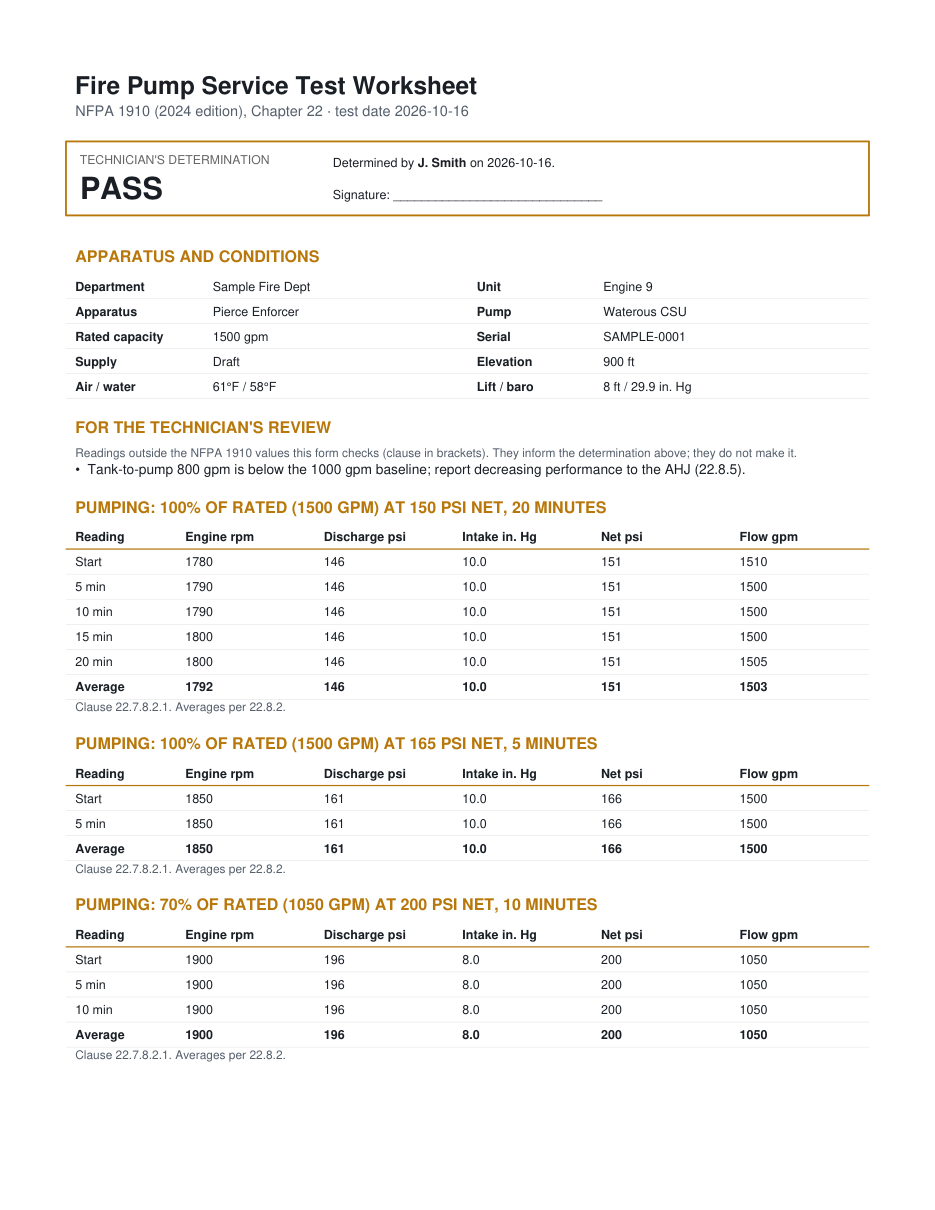
- Fill it in as you test. Enter the pump's rating and the form lays out the runs, readings and limits for that pump, and works out net pump pressure from your gauges. The PDF averages each run.
- Readings get checked as you type. Anything outside the NFPA 1910 values above is listed with its clause, for you to review.
- You decide. You pick Pass or Fail and your name goes on the sheet with a signature line. The flags inform your call; they don't make it.
- Email the PDF to yourself and, if you like, your chief or fleet office. Saved sheets stay on your account to reopen or resend.
Part of an Overhaul Prep membership
The pump test form sits next to an NFPA 1910 quick reference and a pump test calculator, alongside practice tests for every EVT and ASE exam.
See plans →Questions about the pump test
Is the annual fire pump test still in NFPA 1911?
No. NFPA 1911 became part of NFPA 1910 in 2024, and the pump service test is in NFPA 1910 Chapter 22.
How often does a fire pump have to be service tested?
Pump performance test: at least annually; after the repairs listed; and after any modification to the pump or to vehicle components used in pumping. (NFPA 1910 22.2)
How long does the pumping test take?
For a pump rated 750 gpm up to 3000 gpm, at least 45 minutes of pumping across the four runs in the table above. Each run is timed only once pressure and flow are steady at the test point (22.7.8.3), so setup comes on top of that.
What vacuum does the pump have to hold?
Reach at least 22 in. Hg (75 kPa). Above 2000 ft (610 m), the required vacuum drops 1 in. Hg (3.4 kPa) for each 1000 ft (305 m) above 2000 ft. Vacuum must not drop more than 10 in. Hg (34 kPa) in 5 minutes. Then the test is repeated with the intake valves closed (NFPA 1910 22.7.7).
Who decides whether the pump passed?
The technician running the test. The Overhaul Prep form flags readings outside the NFPA 1910 values for them to review; they pick Pass or Fail and are named on the PDF. Overhaul Prep does not inspect, test or certify apparatus.
Keep going
- NFPA 1901 and 1911 are now NFPA 1900 and 1910: which old standard went where.
- EVT F3, Fire Pumps & Accessories and EVT F1, Maintenance, Inspection & Testing: practice for the two EVT tests closest to this.